4. Inverse and derived functions
A function's defining relation can be useful even when you do not use a dedicated constructor. For inverse functions, the relation must select the intended branch. For derived functions, the component expressions must preserve the intended domain.
Prerequisites: exponentials and logarithms and trigonometric constraints.
Choose an inverse branch
The relation sin(y) = x alone does not define the usual inverse sine.
It allows every angle whose sine equals x. The conventional real
principal branches can be described as follows:
| Function | Defining relation | Input domain | Principal output interval |
|---|---|---|---|
asin(x) |
sin(y) = x |
-1 <= x <= 1 |
-π/2 <= y <= π/2 |
acos(x) |
cos(y) = x |
-1 <= x <= 1 |
0 <= y <= π |
atan(x) |
tan(y) = x |
All real x |
-π/2 < y < π/2 |
These are mathematical encodings of the principal real functions. They also explain what you must preserve when replacing a native inverse operator with a relation. The generated operator table in expressions lists the native constructors; their availability does not guarantee a decimal-valued model or a decided query for every input.
"""Show why an inverse sine relation needs a principal interval."""

from std.testing import assert_true
from cvc5_mojo import TermManager, Solver, Kind


def main() raises:
    var tm = TermManager()
    var solver = Solver(tm)
    solver.setLogic("QF_NRAT")
    solver.setOption("incremental", "true")
    solver.setOption("tlimit-per", "5000")
    var angle = tm.mkConst(tm.getRealSort(), "angle")
    var pi = tm.mkTerm(Kind.PI)
    var half_pi = tm.mkTerm(Kind.DIVISION, pi, tm.mkInteger(2))
    var zero = tm.mkTerm(Kind.TO_REAL, tm.mkInteger(0))
    solver.assertFormula(tm.mkTerm(Kind.EQUAL,
        tm.mkTerm(Kind.SINE, angle), zero))
    solver.assertFormula(tm.mkTerm(Kind.EQUAL, angle, pi))
    var unrestricted = solver.checkSat()
    assert_true(unrestricted.isSat())
    print("sin(angle) = 0 with angle = pi:", unrestricted)

    solver.push()
    solver.assertFormula(tm.mkTerm(Kind.GEQ, angle, tm.mkTerm(Kind.NEG, half_pi)))
    solver.assertFormula(tm.mkTerm(Kind.LEQ, angle, half_pi))
    var principal = solver.checkSat()
    assert_true(principal.isUnsat())
    print("the same angle in [-pi/2, pi/2]:", principal)
    solver.pop()
Run from the repository root pixi run --locked mojo run -I src docs/examples/inverse_branches.mojo
Output
sin(angle) = 0 with angle = pi: sat
the same angle in [-pi/2, pi/2]: unsat
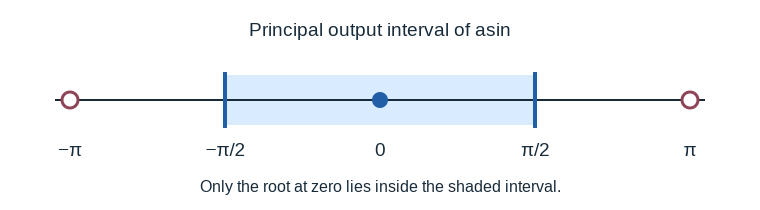
The first query permits angle = π as a root of sin(angle) = 0.
That does not make π the principal value of asin(0). The second query
adds the principal interval and rules that candidate out.
The example establishes the branch restriction's effect on this candidate. It does not claim that a solver will efficiently enumerate all roots or eliminate every inverse operator in a general formula.
Build hyperbolic functions
The real hyperbolic functions can be expressed with exponentials:
The denominator of the last expression is positive on the real domain. The program below builds the first two expressions and checks their values at zero by ruling out a violation of either identity.
"""Build hyperbolic functions from exponential terms and check zero."""

from std.testing import assert_true
from cvc5_mojo import TermManager, Solver, Kind


def main() raises:
    var tm = TermManager()
    var solver = Solver(tm)
    solver.setLogic("QF_NRAT")
    solver.setOption("tlimit-per", "5000")
    var x = tm.mkConst(tm.getRealSort(), "x")
    var positive = tm.mkTerm(Kind.EXPONENTIAL, x)
    var negative = tm.mkTerm(Kind.EXPONENTIAL, tm.mkTerm(Kind.NEG, x))
    var two = tm.mkInteger(2)
    var sinh_x = tm.mkTerm(Kind.DIVISION,
        tm.mkTerm(Kind.SUB, positive, negative), two)
    var cosh_x = tm.mkTerm(Kind.DIVISION,
        tm.mkTerm(Kind.ADD, positive, negative), two)
    var zero = tm.mkTerm(Kind.TO_REAL, tm.mkInteger(0))
    var one = tm.mkTerm(Kind.TO_REAL, tm.mkInteger(1))
    solver.assertFormula(tm.mkTerm(Kind.EQUAL, x, zero))
    solver.assertFormula(tm.mkTerm(Kind.OR,
        tm.mkTerm(Kind.DISTINCT, sinh_x, zero),
        tm.mkTerm(Kind.DISTINCT, cosh_x, one)))
    var result = solver.checkSat()
    assert_true(result.isUnsat())
    print("sinh(0) != 0 or cosh(0) != 1:", result)
Run from the repository root pixi run --locked mojo run -I src docs/examples/hyperbolic.mojo
Output
sinh(0) != 0 or cosh(0) != 1: unsat
Because exp(0) = 1, substitution gives sinh(0) = 0 and cosh(0) = 1.
The unsat result confirms those specific equalities. A universal identity
involving products of hyperbolic terms may require much more work; this
simple example is not evidence that every such identity will be decided.
Positive-base real powers
For a positive real base b and real exponent r, use the identity
b^r = exp(r*ln(b)). A relational encoding introduces base_log:
b > 0
exp(base_log) = b
value = exp(r * base_log)
The positivity assumption is essential for this real logarithm encoding. It excludes zero and negative bases. Integer powers of a negative number are perfectly meaningful, but require a different formulation. Do not apply this transformation to those cases or silently extend it to complex branches.
For a small fixed nonnegative integer exponent, a product of terms often
expresses the intended polynomial directly. For square roots of a
nonnegative real input, the algebraic relation y*y = x with y >= 0
selects the nonnegative root. Square root is algebraic even though it is
often discussed alongside the transcendental operators.
Exercise: why the sign condition matters
Does y*y = 4 define the square root of four?
Worked answer. It allows both two and negative two. Adding y >= 0
selects the conventional square root. This is the same modeling issue as
selecting the principal interval for inverse sine: a relation can admit
more values than the intended function.
Next: proving bounds.